Wednesday, February 23, 2022

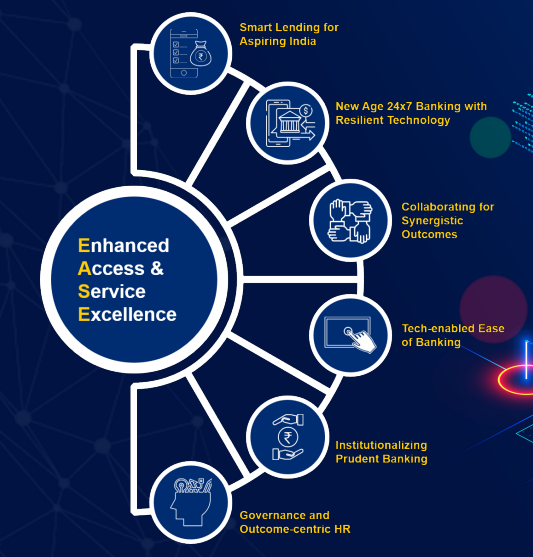
EASE 4.0 - Banking Reform Agenda

 For Ease 4.0 reform agenda implementation, the 2 new themes have been added : -

1. New Age 24x7 banking with resilient technology

2. Collaborative banking for synergistic outcomes


With this, the reform agenda is summarized in 6 broad categories/themes to be implemented in each PSB.


Credit: http://164.100.117.97/WriteReadData/userfiles/EASE%204.0.pdf

Saturday, February 19, 2022

Four Prioroties of Union Budget 2022


  • PM GatiShakti
  • Inclusive Development
  • Productivity Enhancement & Investment, Sunrise opportunities, Energy Transition, and Climate Action
  • Financing of investments

Special Mention Accounts - SMA

Special Mention Accounts are those assets/accounts that shows symptoms of bad asset quality in the first 90 days itself or before it being identified as NPA.

The classification of Special Mention Accounts (SMA) was introduced by the RBI in 2014, to identify those accounts that has the potential to become an NPA/Stressed Asset.  Logic of such a classification is because some accounts may turn NPA soon. Here, an early identification will help to tackle the problem better. There are four types of Special Mention Accounts – SMA-NF, SMA 0, SMA1 and SMA 2.
The Special Mention Accounts are usually categorized in terms of duration. For example, in the case of SMA -1, the overdue period is between 31 to 60 days. On the other hand, an overdue between 61 to 90 days will make an asset SMA -2.
But some ‘Special Mention’ assets are identified on the basis of other factors that reflect sickness/irregularities in the account (SMA -NF). 
In the case of SMA -NF, non-financial indications about stress of an asset is considered.

post credit: https://lms.indianeconomy.net/glossary/special-mention-accounts-sma/

Views on Indian Union Budget 2022

 As expected, India Union Budget, presented by Hon'ble finance minister Mrs. Nirmala Sitharaman, is in line with previous year budget. No big announcement for the year in question, rather a roadmap is given for long way to go. This has come to the expectation of many who have learnt from previous year budget and Government initiatives. The Capex has increase to more than 35% which is the need of the hour to be as developing economy. The "Amrit Kaal" term was coined by PM Narendra Modi on 15th August 2021 which is suitably justified in 2022 budget announcements. The common man taxpayer was expected a bit relief in term of Income Tax slabs, However, the same is not possible as country is reviving from COVID pandemic situation.

Sunday, December 13, 2015

CAIIB - RETAIL BANKING - UNIT 11 DELIVERY CHANNELS IN RETAIL BANKING


UNIT 11 DELIVERY CHANNELS IN RETAIL BANKING


v  Advantages of a good branch layout are

(i)      Promotes efficiency as it will ensure smooth flow of services.

(ii)     Internal communication effectiveness increases thereby facilitating better coordination among the staff resulting in better customer service.

(iii)    Provides a comfortable and congenial work environment to the staff which results in high employee motivation and acts as a morale booster.

        (iv)   Serves as an image building tool for the bank

v  For opening of different liability accounts, branches in the brick and mortar format perform only the role of the marketing function and front office operations.

v  customers were provided with the facility of withdrawing from other banks' ATMs through a common networking arrangement "National Financial Switch"

v  Two of the important net working arrangements called "Cash Tree" and "INFINET-National Financial Switch offered networking facility across banks.

v  Functioning efficiency of ATMs has an impact on  reputation risk for the bank and may result in customer switching also.

v  Net Settlement when the transfer of funds actually takes place, may occur at the same time as the transaction or soon afterward, or it may occur later in the day in POS systems that operate Off-Line in a Store and Forward mode.

v  Globally, mobile banking initiatives were stared by Wachovia in 2005 and the full fledged mobile browser in 2007.

v  Union Bank of India is one of the very early Public Sector Banks to offer mobile banking facility to their customers.

v  Presently, the bank's Mobile Banking works on SMS, GPRS, and J2ME over GPRS facilities

v  General Packet Radio Service (GPRS) is a packet oriented mobile data service, through which the customer can access the services of the bank using his/her MPIN.

v  Reserve Bank of India has recently enhanced the transaction amount through mobile banking to Rs.50,000/ and this higher limit is definitely going to create a greater impact in the mobile banking marketing

v  Ernest. T. Parkins had observed that internet banking, going forward, would have great implications on (1) Internet commerce, (2) new types of electronic retail payments, (3) electronic retail banking, and (4) the movement more generally of retail financial services to electronic delivery, including insurance, discount brokerages, and mutual funds

v  The levels of banking services offered through INTERNET can be categorized in to three
types: Basic Level Service, Simple Transactional Websites, 'Fully Transactional Websites'

v  Security issues include questions of adopting internationally accepted state-of-the art minimum technology standards for access control, encryption/decryption (minimum key length etc), firewalls, verification of digital signature, Public Key Infrastructure (PKI) etc.

v  Merita Nordbanken (MRB) leads in 'log-ins per month' with l .2 million Internet customers, and its penetration rate in Finland (around 45%) is among the highest in the world for a bank of 'brick and mortar' origin.

v  Swedbank was the first bank in the world to introduce Electronic Bill Presentment and Payment (EBPP).

v  If you compare internet banking and mobile banking, mobile banking will score over internet banking as a complete remote channel because of the strong penetration of mobile services across geography including rural areas.

v  While internet banking is an attractive channel for the upper middle end customers who are tech savvy, mobile banking is a universal remote channel attracting bottom of pyramid customers as well as high end customers.

v  In the long run, mobile banking as a remote channel will be the king of delivery channels in retail banking because of its simplicity and reach.
CAIIB - RETAIL BANKING - UNIT 10 MARKETING IN RETAIL BANKING


UNIT 10   MARKETING IN RETAIL BANKING


v  The fundamental ingredients of an effective marketing mix in retail banking which are as follows:

(i)    Product

(ii)   Price

(iii)  Promotion

(iv)   Place

(v)    People

(vi)   Process

(vii) Physical evidence

v  In the case of deposit products, 'Price' refers to the interest rate offered by the banker to the customer.

v  process relates to all organisational activities which go into the marketing of the final product to the customer including delivery channels.

v  Physical evidence refers to developing tangibility to the intangibility concept of banking services.

v  Delivery Channels are basically of two types. Physical Channels and Remote Channels

v  Branches and Extension Counters are referred to us Physical Channels.

v  Remote Channels also called as Electronic Channels  designed to serve customers outside the branch and includes ATMs, Internet Banking and Mobile Banking.

Tuesday, June 16, 2015

CAIIB-RETAIL BANKING-UNIT 9 REMITTANCE PRODUCTS


UNIT 9 REMITTANCE PRODUCTS


v  The parties to a funds transfer under NEFT System are

the sending bank,

the sending Service Centre,

the NEFT Clearing Centre,

the receiving Service Centre and

the beneficiary branch.

v  NEFT messages generated for destination banks will be transmitted to the service centre of each receiving banks using SFMS.

v  In case of a holiday at the beneficiary branch, the credit will have to be effected on a value dated basis wherever feasible or latest at the commencement of business on the next working day.

v  Customers can complain to the Banking Ombudsman if the complaint is not resolved within thirty days.

v  As per  Payment System Bill, 2002, a 'payment system' means "a system that enables payment to be effected between a payer and a beneficiary and includes clearing, settlement or payment service".

v  In RTGS The remittances are credited on a dynamic basis and settlement also made on a dynamic basis

v  In "Customer Payment Transaction", customer information along with the payment message can be transmitted in a structured format.

v  Electronic Clearing Services (ECS) is a mechanism to effect payments to a desired beneficiary on a periodical basis for the monies payable to them.

CAIIB-RETAIL BANKING-UNIT 8 CREDIT AND DEBIT CARDS


UNIT 8 CREDIT AND DEBIT CARDS
 
v  Credit Cards had their origin right from 1800s.
v  The first universal credit card that could be used at a variety of stores and businesses — was introduced by Diner's Club Inc., in 1950.
v  Citibank and HSBC were the pioneers in the Indian credit card market in the 1980s
v  Among the public sector banks, Andhra Bank, Bank of Baroda were the early starters followed by Bank of India.
v  The minimum qualifying Credit Card score is fixed as 50 by the public sector Bank.
 

CAIIB-RETAIL BANKING-UNIT 7 IMPORTANT RETAIL ASSET PRODUCTS


UNIT 7 IMPORTANT RETAIL ASSET PRODUCTS

v India has got the biggest advantage as regards to population and comprises of a good percentage of youth and this advantage is called “Demographic Dividend”.

v Stand alone model for retail loan processing refers to processing of retail loans independently at the branch level.

v Centralised Model for retail loans processing refers to processing of loans at a centralised place depending upon the geography of branches.

Monday, June 15, 2015

CAIIB-RETAIL BANKING-UNIT 6 - CREDIT SCORING


UNIT 6
CREDIT SCORING

v                    (i)  Credit Risk  -           Customer fails to pay

                                 (ii)  Business Risk          -           Loosing money due to wrong strategy.

                                 (iii) Market Risk            -           Change in market prices.

                 (iv)Operations Risk-     Processing failures and frauds


v Cibil-TransUnion model gives scores ranging from 300 to 900

v  Credit Scoring Models are based on the following details of applicants:

(i)         Family Size

(ii)        Income Levels

(iii)       Occupation/Business

(iv)       Repayment History on earlier loans

v  The most common mistakes in credit score will be due to the following;

(i)         Confusion of names

(ii)        Human Input Error

(iii)       Identity Theft

CAIIB-RETAIL BANKING-UNIT 5 PRODUCT DEVELOPMENT PROCESS


UNIT 5 PRODUCT DEVELOPMENT PROCESS


Ø Product is the fulcrum on which the entire retail banking revolves.

Ø  Product is  "Anything that has the capacity to provide the satisfaction, use and return desired by the customer".

Ø The first stage is the 'introduction' stage when the product is introduced. The sales volume will be low and revenue from the products will not be sufficient to cover the cost of producing, marketing and servicing it.

Ø In the 'growth' stage, which is the second stage in the product life cycle, the sales volume of the product picks up and the product is likely to break even and start generating profits for the organisation.

Ø In the third stage which is the 'maturity' stage, there is more growth and sales volume peaks. Here there is a wide customer base which will result in maximisation of sales with inflow of business and profits.

Ø In the fourth stage, which is the 'staleness' stage or 'saturation' stage, because of competition and better products available from the competitors, staleness will creep in, which will result in saturation of sales.

Ø the final stage of the product life cycle called as 'decline stage'. In this stage, the product becomes less attractive for the consumers due to various reasons and results in drop in sales volume and profits.

Ø Augmented products are products which are developed from formal products by combining two core products and adding value to the product in terms of benefits and comforts to the customer.

Ø  Products can be broadly classified into following:

(i)         Deposit Products or Liability Products

(ii)        Asset Products or Retail Credit Products

(iii)       Other Products and Services.

Ø  The Generic Product - the core product.

Ø  The Expected Product - adding additional features.

Ø  The Augmented Product- adding value in addition to features.

Ø  The Potential Product - futuristic features in anticipation.

Ø In the liability side, Banks offer different retail products like Demand Deposits, Time Deposits with different variations with regard to product features and duration.

Ø In the asset side banks offer mainly Home Loans, Auto Loans, Personal Loans and credit lines against credit card receivables.